 HutchBook.com
Welcome to HutchBook.com!
HutchBook.com content is copyrighted. Citing material is permitted only if HutchBook.com is listed as the source.
◄◄HutchBook.com Links►►
-
For information on specific Hutchinson bottles, visit the HutchBook Bottle Directory database listing over 21,600 different Hutchinsons.
-
To contact knowledgeable individuals concerning specific Hutchinson bottles, here's a link to a list of Collector Specialists.
-
If you aren't sure your bottle is a true Hutchinson, link to the Hutchinson Bottle Sales Guide to review the illustrations and descriptive information.
-
Our Contact Us page includes HutchBook.com guidelines and contact information.
◄◄ HutchBook.com News►►
Updated: April 11, 2025
Outstanding new bottle book just published!
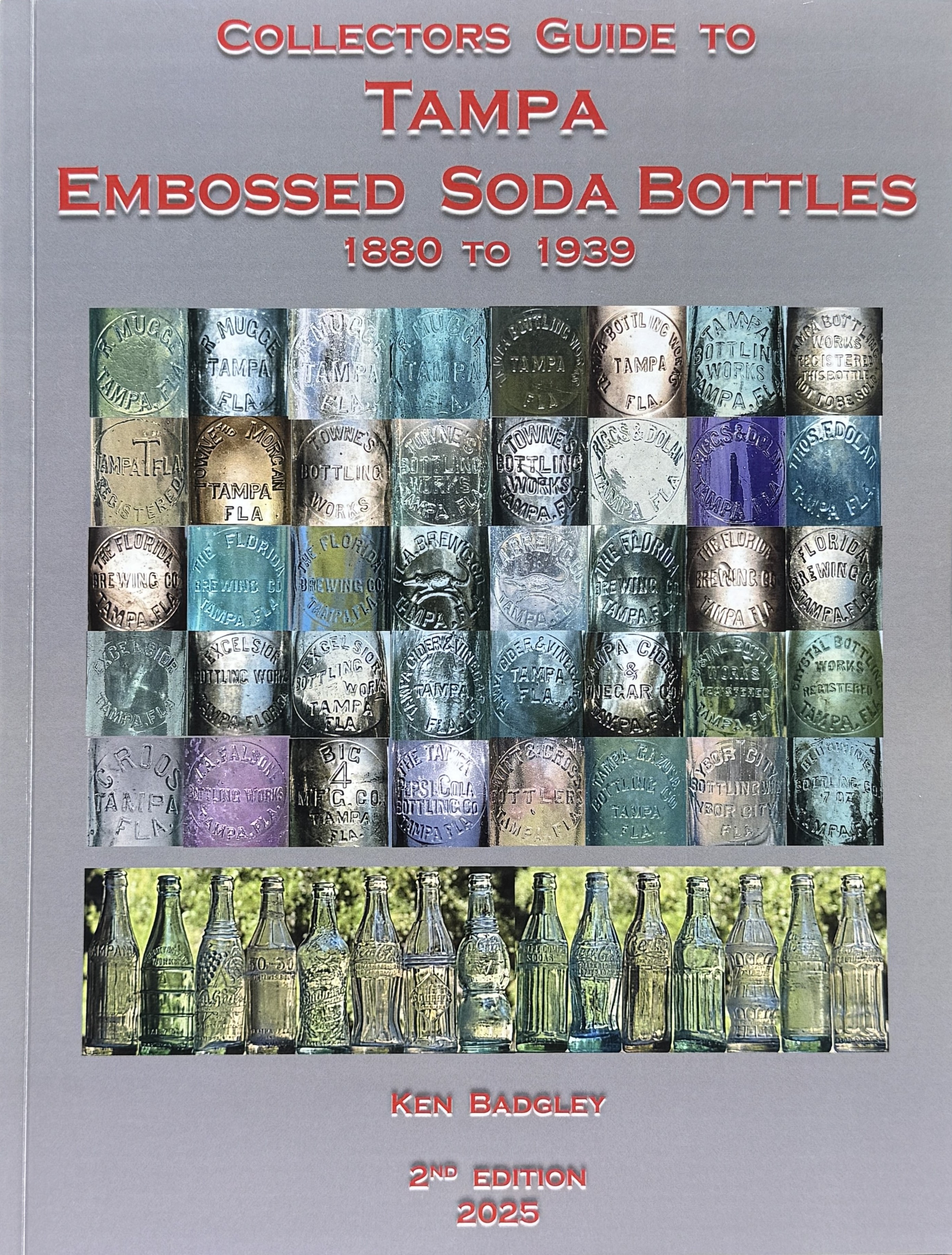
An updated and expanded second edition of Ken Badgley's Collectors Guide to Tampa Embossed Soda Bottles 1880 to 1939 has just been published. Included are 178 color pages with over 500 bottle photos, all 48 known Tampa Hutchinson variants plus eight Baltimore Loop Seal bottles, rarity grading, and a price guide for over 216 bottles. This book is a must have for any bottle collector, not just Florida collectors. Click this link for full details and ordering information:
Updated: December 31, 2024
So much for 2024...
Here's the annual review of statistics covering the previous six years:
2019 2020 2021 2022 2023 2024
-
Listings updated: 1,465 618 1,669 1,412 1,696 1,160
-
Newly catalogued: 249 173 342 286 252 249
-
Total catalogued: 20,399 20,552 20,872 21,141 21,375 21,601
-
Total images posted: 20,671 21,284 22,500 23,501 24,441 25,293
-
Images added/replaced: 1,153 613 1,216 1,001 940 852
-
Hours invested: 767 475 1,430 1,149 1,103 608
My personal investment in the Hutchinson Bottle Directory initiative has increased to a total of over 24,000 hours during the past 48 years.
HiresBook.com has been converted to HiresRootBeerHistory.com and the site now has a total of over 3,500 Hires images posted.
Ron F.
Updated December 31, 2024
Please Help Us Kill These Hutchinson Myths!
An index to the "Archived 2013 Hutchinson Highlights" articles is included in the "HutchBook.com Development" listings at the bottom of this Home page. Click the link to the articles, search the index for the topic you are seeking, and click the title for a quick link to the article. These articles were re-posted because so many people continue to repeat tired Hutchinson myths rather than reading, comprehending, and sharing factual information with fellow collectors and the public. Click this link to the Archived 2013 Hutchinson Highlights index to view articles concerning Hutchinson myths:
-
Hutchinson Myths That Just Won't Die
-
Hutchinsons Were NOT Used For Bottling Beer
-
Pure Food and Drugs Act of 1906 did NOT "ban" usage of Hutchinson bottles!
Updated: December 31, 2024
Improving Your Hutchinson Bottle Sales
Successful sellers are routinely incorporating HutchBook.com data into their sales listings. Doing so takes minimal time and helps many sellers enjoy almost 100% sell thru. Check the GreedyBay sales success of sellers "Rosie17" and "jays-emporium" as examples. Unfortunately, many sellers do a very poor job of describing the bottles they are listing and are left wondering why their bottles don't sell. Hutchinsons are often classified as beers (they were NOT used for bottling beer!), whiskeys, milks, medicines, and other incorrect categories. Another common mistake is describing Hutchinsons as "Huch," "Hutchison," and "Hutcheson" bottles; potential bidders won't find your listings when searching if Hutch or Hutchinson isn't spelled correctly! And "see photos" is not an adequate description; provide the data collectors are looking for! We understand the challenge facing sellers with little or no bottle collecting knowledge, but wonder why experienced collectors don't take time to accurately describe their bottles. Understanding the basic types of soda closures isn't rocket science, even for those styles often confused with bottles that utilized Hutchinson's Patent Spring Stoppers. We frequently see Gravitating Stopper, Floating Ball Stopper, and Baltimore Loop Seal bottles described as Hutchinsons. If you are interested in improving your sales, review the "Hutchinson Bottle Sales Guide" in HutchBook.com's Collecting section and consider incorporating the suggestions into your bottle listings. Here's a link to the page:
HutchBook.com Development
HutchBook.com is designed to serve as a widely used reference source
that will benefit collectors, historians, archaeologists, and other
interested users. The Hutchinson Bottle Collectors' Association
(HBCA) sponsors free public access to HutchBook.com. HBCA members
support and promote historical research by collecting, preserving,
studying, documenting, displaying, communicating, and sharing
information about the antique bottles that utilized Charles G.
Hutchinson's Patent Spring Stopper.
Since the Hutchinson Bottle Directory initiative's founding in 1976, over 1,000 people have contributed bottle data and related information for this project. The following portions of the site document the project's historical development:
-
Hutchinson Bottle Directory Overview (Updated: January 28, 2013)
-
HutchBook.com Announcement (January 4, 2006)
-
Hutchinson Bottle Directory Updates (July 17, 2004 thru September 30, 2008)
-
HutchBook.com Updates (October 31, 2008 thru October 2, 2009)
-
Project Status Reports (September 30, 2009 thru July 4, 2012)
-
Archived Hutchinson Highlights (December 31, 2012 thru December 1, 2013)
HutchBook.com Implementation
Phase I: Hutchinson History (launched September 30, 2009)
HutchBook.com Phase I focuses
on historical development of the
North American soft drink industry
during the 1879 to World War I Hutchinson Era.
Site content includes extensively researched, factual
documentation concerning: the origin of the term "soda pop;" the
evolution of bottle closures, including 30+ stopper patents often
confused with Hutchinson’s Patent Spring Stoppers; a history of the W.
H. Hutchinson and Son company; Hutchinson's lawsuits; the American
bottling system; pre-Hutchinson Era bottling; Hutchinson bottles; the
Hutchinson bottling process; and much more.
Printed out, the content is 300+ pages in length!
Phase II: Bottle Directory (launched August 1, 2012)
HutchBook.com’s
newest feature is the Hutchinson Bottle Directory, a fully
searchable, free access database cataloguing extensive data on
over 21,000 different Hutchinson bottles. The powerful new
“Hutchinson Search” engine is a gateway to detailed data about the
To access the database and its related features, click on the Bottle Directory link located in the left side navigation bar on any HutchBook.com page.
Phase III: Bottle Illustrations (commenced August 1, 2012)
Phase III is the addition of photographs, scans, and computer-assisted drawings to accompany individual Hutchinson bottle listings. Over 25,000 images are now posted on-line, with more being continually added.